
What Washington County Deed Records Convey
Washington County deed records trace every transfer of land and every interest in land. Each instrument is indexed by the parties named in it. A practical Washington County property search starts with a current owner of record or a deed already in hand. From there you follow grantor and grantee names backward. Check legal descriptions and prior-recording references at each step. Digital access is only one layer. The same chain often continues in courthouse indexes, deed books, microfilm, plats, tax records, and court-order files.
| Deed Type | What It Does | Common Use |
|---|---|---|
| General warranty deed | Conveys the stated interest with broad covenants | Ordinary sale |
| Special warranty deed | Uses narrower covenants tied to the grantor's period | Limited-warranty transfer |
| Quitclaim deed | Conveys whatever interest the grantor may have | Family or corrective transaction |
| Executor, commissioner, or fiduciary deed | Transfers through an authorized estate or court role | Estate or judicial matter |
| Tax deed | Documents a later transfer following the required tax process | Do not confuse with a tax-lien certificate |
Not every instrument conveys title. A mortgage, easement, restriction, or lien can burden an interest without moving it. Read each deed in context by following related assignments, releases, and restrictions across the chain.
Washington's 1792 Collection and the 1960 Pivot
According to the Clerk, legal documents are maintained from 1792 to the present. Most indexes reach back only to 1960. So do most document images, which begin in January 1960, with exceptions. "Maintained" does not put every historical page online. That distinction decides whether a deed search continues in eCCLIX. Or it shifts to an office index and a deed book.
Washington County was carved from Nelson County in 1792. A very early land trail may need predecessor-county records. It may also need Kentucky land-patent research beyond the Washington books. Note the jurisdiction and date at every step. Do not force older land into a modern county frame.
Read Names and Legal Descriptions Together
Party names open the index. But the land description proves whether two entries cover the same property. Weigh acreage, calls, and exceptions together. Add lot and block, subdivision name, adjoining owners, and prior book and page references. Springfield annexation material offers useful local examples. Carolina Heights and Clearview references carry plat cabinet and slide citations. Those citations can bridge an ordinance, a plat, and the present parcel.
Search individuals under initials and spelling variants. Try a trust, estate, company, commissioner, executor, or sheriff as the recorded party too. For a business, confirm the legal name. The Kentucky Secretary of State entity search handles that.
Recognize the Clerk's Online Route
The Clerk's legal-records page is the official coverage and routing source.
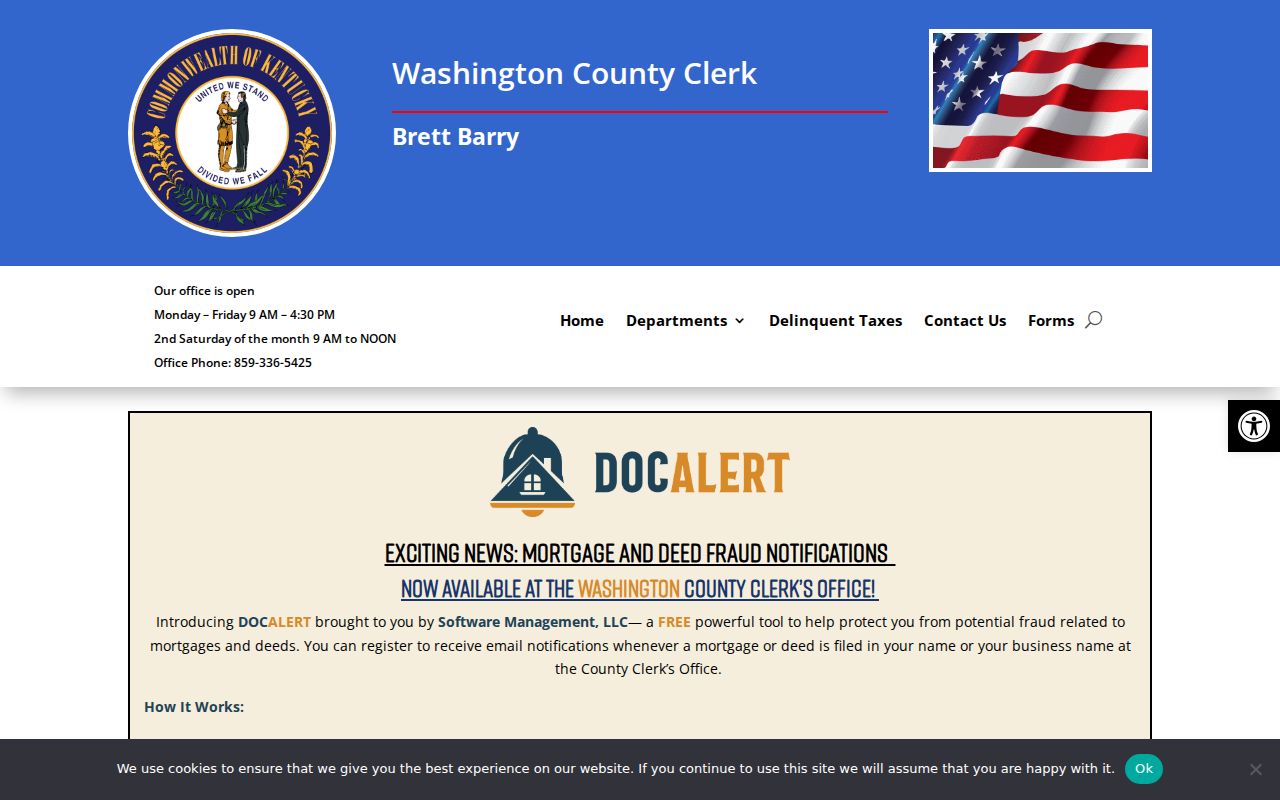
Check the stated exceptions before assuming a missing eCCLIX image means no recorded deed exists. The Clerk's current statements on that page control the question.
Follow Washington County's Grantor-Grantee Index
Start from the newest reliable deed and work backward. Keep every date and reference so two people with similar names never collapse into one chain.
- Find the current acquisition deed with the present owner indexed as grantee.
- Read the grantor, recording date, legal description, and prior deed reference.
- Search that grantor as a grantee to locate the earlier acquisition.
- Repeat while the parcel description remains consistent; at the online cutoff, move to deed books or microfilm.
- Grantor
- The party conveying the stated interest.
- Grantee
- The party receiving the stated interest.
- Chain of title
- The ordered sequence of instruments affecting the same land.
- Book/page or instrument number
- The Clerk reference used to retrieve a recorded document.
Continue Before 1960 With Books and Microfilm
When eCCLIX coverage ends, ask the Clerk for help. Ask which grantor and grantee index volume covers the date and surname. A second route runs through the Kentucky Department for Libraries and Archives research guides. The same route also leads to the state microfilm catalog. FamilySearch catalogs Washington County court-order material. The Washington County Public Library holds local histories, newspapers, and cemetery sources. It also keeps microfilm and in-library genealogy databases.
Context like that can explain an estate, a name change, or a local place name. It cannot replace the deed, will, or court order itself. Whenever a historical clue advances the chain, cite the reel, volume, page, and date.
Watch Deeds, Mortgages, and Estate Transfers
The Clerk links DOC ALERT. It is a free monitoring service. It emails you when a new deed or mortgage is filed under a name. Treat each alert as a prompt to inspect the instrument. It is not proof that a filing is valid or that title changed.
Estate chains may bring in wills. They may also include affidavits of descent, conversion of real estate, fiduciary deeds, or court orders. Search the decedent, the estate, the heirs, the executor, and the personal representative. A jump in the deed chain often points to probate. It may also point to Circuit Court records holding the missing authority.
Obtain a Washington County Deed Copy
Use an online image when available, inspect indexes and records free at the Clerk's office, or send a focused request to Washington County Clerk, 117 North Cross Main Street, Suite 1, Springfield, KY 40069. The office publishes its recording fees, but the research did not verify an exact local plain-copy or certification charge; request the current amount before sending payment.
An Open Records request should identify the parties, approximate date, instrument type, and recording reference. The Clerk's policy calls for a determination within five working days, excluding weekends and legal holidays, under the Kentucky Open Records Act, KRS 61.870-.884.
Recorded, not guaranteed. The index reports filed instruments; it is not a title opinion, does not resolve every unrecorded interest, and cannot replace professional title examination.
Build a Washington Deed Capture Sheet
For each candidate instrument, capture the indexed grantor and grantee exactly as written. Add the instrument type, execution and recording dates, book and page or instrument number. Note the consideration if displayed, plus the legal description, acreage, subdivision and lot, image status, and the prior-reference citation. Then note the next search to run. This inventory keeps a surname match from masquerading as a parcel match. It also exposes gaps, like a missing release or an estate transfer.
An index row alone is an index result, not a deed copy. Label it that way. If the legal description is abbreviated, retrieve the image before moving the chain forward. A prior deed citation usually beats a broad surname search. It may carry you straight across the 1960 digital boundary.
Search Encumbrances Alongside the Deeds
Deeds alone never tell the whole story in Washington County. A careful deed records search also pulls mortgages, assignments, releases, easements, restrictions, judgment liens, mechanic liens, and tax liens filed under each owner of record. Match every release to the instrument it satisfies. A later deed does not erase an earlier recorded burden on its own. UCC filings live in a separate Secretary of State system. A fixture filing or recorded instrument may tie one to real property.
Litigation leaves its own trail. For an unresolved foreclosure, lien, or quiet-title dispute, the Washington County Judicial Center and CourtNet show the court activity. The Clerk's index holds the recorded lis pendens, order, release, or commissioner's deed that settled it. The court docket tracks the case; the recorded document marks the land-record event. Checking both gives you the full sequence.
Older volumes need their own care. The county's official history highlights an active historic courthouse. That alone does not prove every early deed book still sits onsite or survives without a gap. Ask the Clerk or Circuit Clerk which index ledgers and deed books remain in the office. Ask which are stored elsewhere, and which exist only on KDLA microfilm. Write down the catalog number, volume, page, reel, and date for each item. Keep the courthouse and archival routes in one research file so nothing drifts apart.
The Washington County Public Library's genealogy collection adds useful context. Newspapers, obituaries, cemetery records, local histories, microfilm, and in-library databases can explain a surname change, an estate, or a family relationship that surfaces in a deed chain. Treat them as supporting evidence only. Before stating that ownership transferred, return to the recorded deed, will, affidavit, or court order itself.