
Read Washington County Property Tax Records
Two stops cover most of it. Use the PVA search for the assessment parcel and the Sheriff's tax page for the current bill. The live bill settles exact amounts and status.
| Field | What It Shows | Where |
|---|---|---|
| Parcel and Alternate ID | Cross-office account keys | Washington PVA |
| ASV / assessment value | Value field requiring year verification | Washington PVA |
| Exemption | Tax relief reflected on the assessment | PVA and Kentucky Revenue |
| Bill amount and status | Current-year charge and payment state | Washington County Sheriff |
| Delinquent certificate | A tax lien interest, not ownership | Washington County Clerk |
Kentucky assesses real property at 100 percent fair cash value. State ratio studies monitor county assessment levels, and assessment, taxable value, tax due, and sale price remain distinct figures.
Three Offices Divide Washington's Tax Cycle
The Property Valuation Administrator assesses every parcel. The Sheriff collects current property taxes through April 15. On April 16, unpaid bills turn delinquent and transfer to the County Clerk, whose delinquent-tax page covers registration and sale details. A tax-lien certificate is not a deed. The Clerk says plainly that a certificate sale does not transfer ownership, so follow redemption, court, and later recorded instruments as their own events.
The January 1 Tax-Owner Quirk
The Sheriff issues each bill to the owner of record on January 1. That date drives everything. A deed recorded later puts the new owner in the Clerk's record while the same year's bill still shows the earlier name. Neither record is wrong. Compare the tax year and the deed date. Note: The exact Washington PVA update lag is not published, so confirm a recent transfer directly with the Clerk and the PVA.
See the Sheriff's Washington Tax Route
The Sheriff property-tax page supplies the county's bill-search instructions.
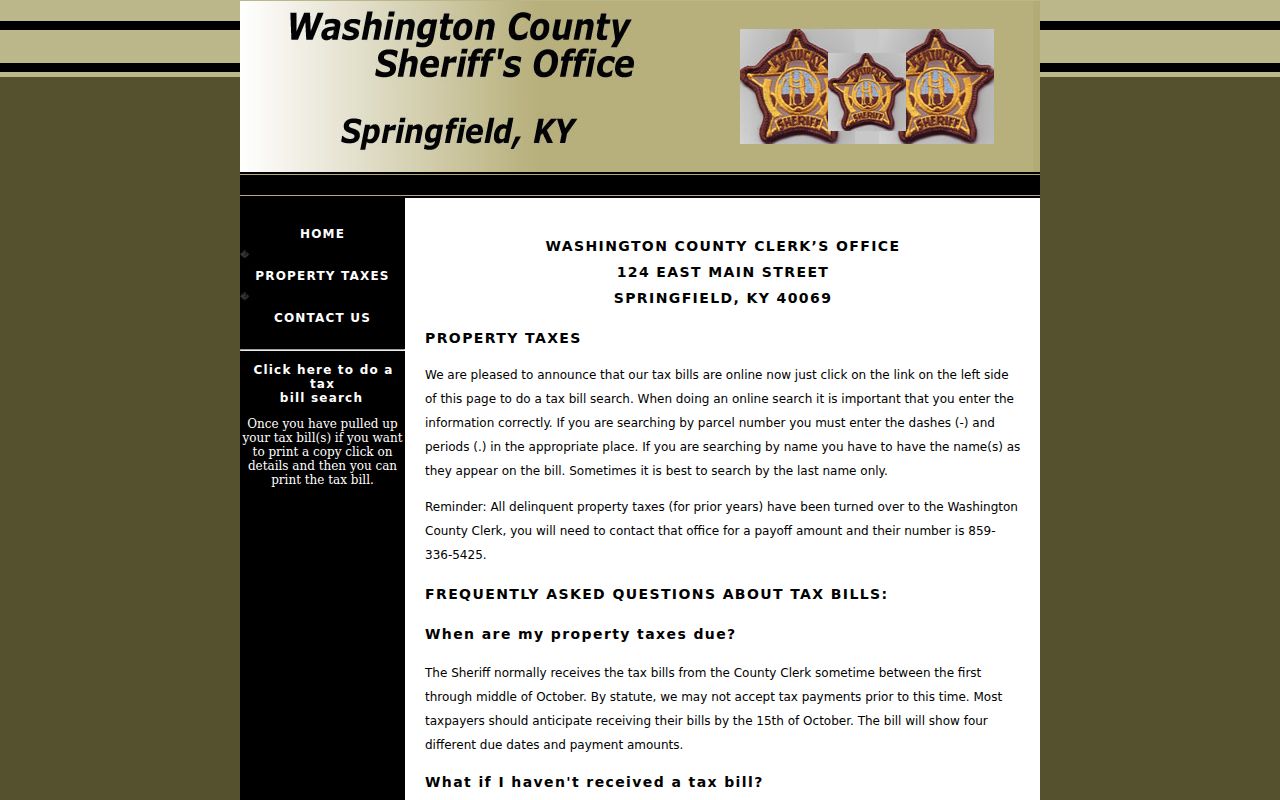
Keep the tax year, status, and parcel-format directions shown, and follow the payment instructions as posted.
Look Up a Washington County Tax Bill
The Sheriff points users to its linked Properly Taxes system. Query it by parcel number or name, and leave out dashes and periods.
- Find the PVA parcel and copy both identifiers.
- Search the tax bill by the unpunctuated parcel number or owner name.
- Record bill year, billed owner, amount, and status exactly.
- Check exemptions at the PVA; for delinquency, continue with the Clerk.
- Fair cash value
- Kentucky's real-property assessment standard.
- Taxable assessment
- The assessment after applicable treatment and exemptions.
- Homestead exemption
- Statutory relief for qualifying owners.
- Tax lien certificate
- An interest arising from delinquent taxes, not a conveyance.
Apply Washington Exemptions Carefully
The Kentucky Department of Revenue publishes the homestead and disability exemption route, and the PVA's stated class matters because agricultural, residential, and commercial property can draw different appraisal approaches. The exemption amount is $49,100 for 2025–2026. Verify the current period and eligibility.
Follow Delinquency Without Assuming a Transfer
The Clerk publishes the delinquent list and its procedure. The next sale reference reads August 4, 2026. Keep the original bill, Clerk transfer, certificate, redemption, court case, and later deed as separate events. Current bills stay with the Sheriff. Annual dates shift, so recheck them; payment runs in person, online, or by the Sheriff's published contact route, and older delinquency belongs to the Clerk.
Contest a Washington County Assessment
The PVA appeals process opens each May. A conference comes first. From there, a dispute can reach the local Board of Assessment Appeals and a state route, so bring the property card, photographs, measurements, comparable sales, and any evidence of classification or condition.
Appeal window. Use the PVA's current notice for that year's May inspection and filing dates; the research did not support one permanent calendar deadline.
Compare ASV, Sale Price, and the Tax Due
The qPublic result grid carries an ASV label. Read it in context before calling it market value or taxable value. A deed's consideration is a transaction fact. The PVA's fair-cash assessment is an administrative valuation. The bill reflects taxable assessment, rates, and exemptions. None of these says what the parcel would sell for today. Kentucky's Department of Revenue describes sales, cost, and income approaches plus a 90-to-110 percent ratio-study range. Those statewide standards help you interpret a local assessment, but they never yield a parcel-specific conclusion.
Use Every Washington Tax Access Channel
Start online with the PVA and Sheriff systems. They answer most questions. When a result fails, ask the PVA for the assessment card and parcel identifiers. Ask the Sheriff for the bill and payment record. After transfer, the Clerk holds the delinquent bill, certificate, registration, and sale materials. A Kentucky Open Records request can describe a record by parcel, owner, tax year, and record type when the ordinary portal does not provide it.
Springfield billing is a separate local question. A Springfield mailing label does not create a city bill, so confirm whether the parcel sits inside corporate limits first. For older disputes or collection litigation, CourtNet and the Circuit Clerk can add case context. The tax office record still governs the bill itself.
Preserve a Year-by-Year Tax Timeline
Track one row per tax year. Record the parcel ID, billed owner, assessed value label, exemption, amount, payment status, source, and access date. Give deed dates and any parcel split or merge notes their own columns. A name change could reflect the January 1 billing date. It could also reflect a later conveyance or an identifier update. The timeline shows which. It also keeps a current paid bill from being mistaken for an older delinquency.
A parcel can sell mid-year. When it does, add the Clerk recording date and the deed parties alongside the printed bill name. Do not overwrite that name. Closing prorations are private transaction details. They never change which owner the Sheriff used for the January 1 bill. If a PVA ownership entry shifts, date that observation too, since the county publishes no exact update lag.
Prepare early for an assessment review. The May inspection-period conference comes first. Before it, gather the PVA card, the notice, photographs, measurements, condition evidence, classification, and comparable sales. Kentucky Revenue describes the sales, cost, and income approaches and a 100-percent fair-cash-value standard. Those statewide rules frame the process, but they cannot replace Washington County's parcel facts or the annual appeal notice.
Keep current and delinquent access routes separate. The Sheriff handles the current-year search and collections through April 15. The Clerk takes over unpaid bills starting April 16. It publishes the delinquent-tax process, registration details, and dated sale material. An online result can go missing. Contact the responsible office with the parcel, owner, and tax year. Or file a focused public-record request rather than assuming no bill exists.
Finally, separate county and municipal charges. A Springfield postal address does not mean the parcel sits inside Springfield's corporate boundary or receives a city bill. Confirm city limits through current boundary and annexation sources, then note the issuing authority printed on each bill. Willisburg and Mackville offer no official online municipal tax portal, so do not infer one.